My Journey
I like to start telling my story from the beginning, because I believe my career begins long before the first "hello world".
Still very young, at just 2 years old, I had the opportunity to go to Japan. My parents went for work and, combining two stays in the country, I lived there for approximately 8 years. It was during this period that I acquired my knowledge of Japanese and also the reason for some easter eggs scattered throughout this site.
Beyond the cultural aspect, living in Japan gave me something that made a huge difference: access to technology. Like it or not, access was much greater than in Brazil, where my parents couldn't afford to provide this kind of resource. With that came curiosity. I liked tinkering with things, taking them apart, testing, understanding how they worked. That's why I earned the nickname "tinkerer" among my parents, friends, and even teachers.
In my last stay in Japan, between ages 11 and 12, I already had a clear conviction: I wanted to pursue a degree in some technology-related field.
Back to Brazil and First Jobs
When I returned permanently to Brazil at age 12, I arrived a bit lost. I was in seventh grade and had only studied two years in Brazil, which brought me a lot of difficulty with Portuguese — although I was already better than the first time, when I basically only knew how to write my name.
A year later, I started working as a waiter on weekends at my uncle's restaurant inside the Municipal Market. I earned R$20 per Saturday and Sunday, and that's how I bought my first cellphone, a Sony Ericsson. Since I really liked communicating, I stood out and started doing some extra work during the week at a pastry shop next door.
After about a year, I started working at the famous "Aurora Stand", a stand selling candy, fishing supplies and country goods, also inside the market. Initially it was part-time, but in practice I worked Sunday to Sunday, no days off. It was tough, but extremely formative.
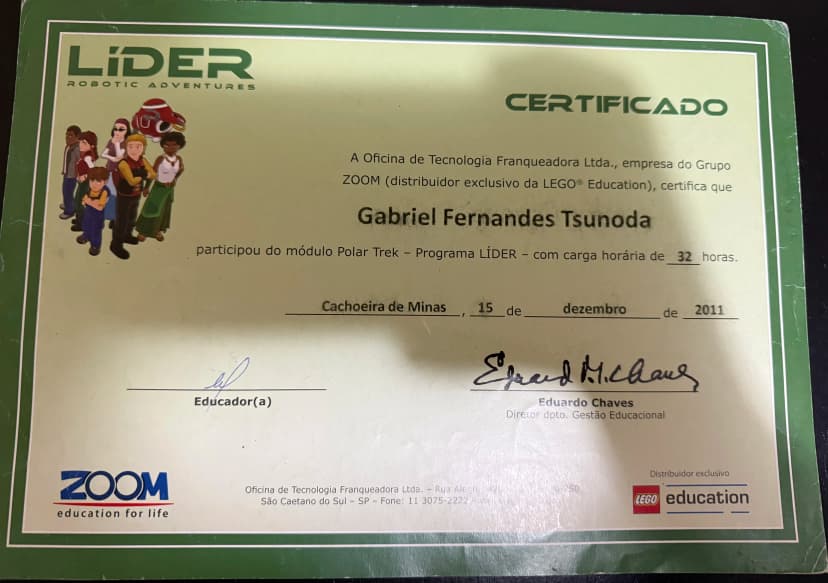
It was during this phase that I participated in my first LEGO robotics tournament, the First Lego League. That was my first contact with programming. Even though it was low code, I needed to program sensors, create conditional logic and understand flows. We didn't advance far in the tournament, but there the first seed of my career in technology was planted.
High School and the First Click
At 14, I made an important decision: I transferred my enrollment to evening high school and started working full-time. It wasn't easy to balance work and study, but it was necessary. Today, looking back, I see how important this phase was for my maturity and, especially, for my communication. It was also during this period that I bought my first laptop — a Positivo.
At 15, an opportunity came up for a high school internship at APTIV (formerly Delphi), a multinational company in the city. I passed a competitive selection process, with only 2 spots for 10 candidates. When I received the call confirming my acceptance, it felt like a dream: I would work 6 hours a day, Monday to Friday, earning more than at the municipal market.
The internship work was simple: chasing signatures, printing technical drawings on giant printers, learning a bit of Excel and handling administrative routines.
It was during this period that something completely changed my vision of the future. My late brother-in-law, an electronics technical teacher, one day wrote a simple code in front of me, with if, else and a terminal interaction. My eyes lit up. At that moment, I was certain: this is what I wanted to do.
Until then, my plan was to study Computer Engineering, probably at Inatel.
Technical Course and the Tetris in C
My brother-in-law took me to a technical school during an annual project fair. Seeing what the students developed there really impacted me. I enrolled — not for Electronics Technician, but for Computer Technician.
The technical course lasted two years and was a turning point in my life. There I had my first real contact with programming: C language, pointers, data structures, logic, databases and SQL. It was during this period that I began to understand how things really worked.
During the second and final year of the technical course, an opportunity arose to return to the same company where I had interned in high school, now as a technical course intern. Besides a better salary, I started working with low code, helping to program test benches and automotive harnesses. The work involved many conditional blocks and required constant logical reasoning.
Alongside the internship, in the technical course itself, I began learning Object-Oriented Programming with Java, used Swing, had contact with Android development and advanced considerably in SQL. This combination of practice and theory was fundamental to consolidating my foundation.
In the final year of the technical course, we needed to present a final project at the school fair — the same fair I had visited before enrolling. I decided to challenge myself by creating a Tetris in C, using the Allegro library for the graphical interface. It was extremely challenging, but I managed to finish and present a complete and functional project.
In 2015, I completed the technical course and also finished my internship. I had already finished high school in 2014 and left this phase with the certainty that programming wasn't just an interest — it was the path I wanted to follow.
The Professional Detour
In 2016, at 18 years old, I started working as a technical assistant at a knife factory in the city. I began working with Corel Draw, AutoCAD and CNC with G-code. And yes — none of this had anything to do with programming.
Even so, during the following three and a half years, I spent nights and weekends studying programming. I learned JavaScript, built small projects and started creating my first personal experiments just to keep the momentum and continue evolving.
During this period, I started my Information Systems degree at Univas (private). After a year, I managed to transfer to UNIFEI (federal university in Itajubá), after a difficult exam focused on calculus and programming.
I felt behind and hopeless, until in 2019 everything changed.
First Opportunity as a Dev
In 2019, I got my first opportunity as a developer at a software house. For that, I needed to move to a different city, live in a shared house and accept a lower salary than what I was earning at the time. It seemed like a step backwards, but it was the missing piece.
After 3 months, I received a raise. After another 3 months, another one. In about a year, I reached R$3,500. I'm not proud of how I negotiated some raises, but at that moment I needed to grow financially while learning as much as possible.
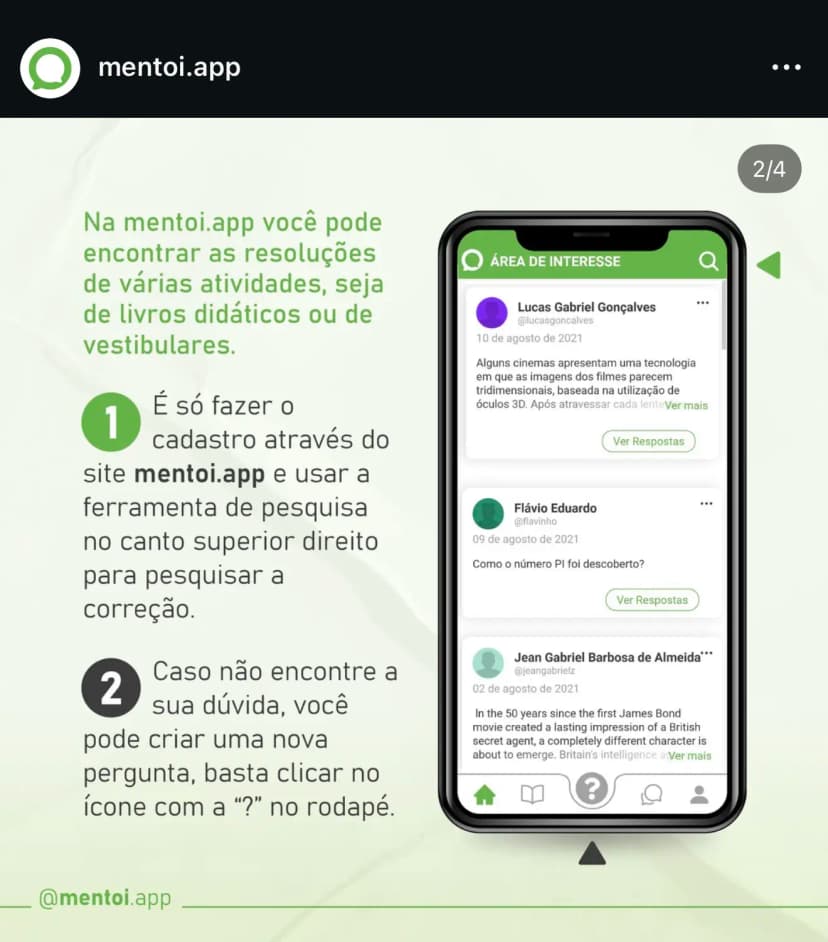
It was during this period that, in 2020, I created my first more robust personal project: Mentoi, a Q&A platform where only authenticated people with validated knowledge could answer.
With the pandemic, I started working from home and was able to return to my parents' house.
The Birth of Tsunode
At the software house, I started working with Java, Hibernate and PrimeFaces. Then I moved to PHP with CodeIgniter and Laravel. It was the phase where I learned the most about JavaScript, CSS, jQuery and Bootstrap, always going beyond what was asked.
Over time, I started taking on the company's Node.js projects. I studied a lot, took courses, got into React and React Native, and JavaScript became my main stack.
That's when the nickname Tsunode (Tsunoda + Node) was born. The name stuck and ended up becoming my personal brand.
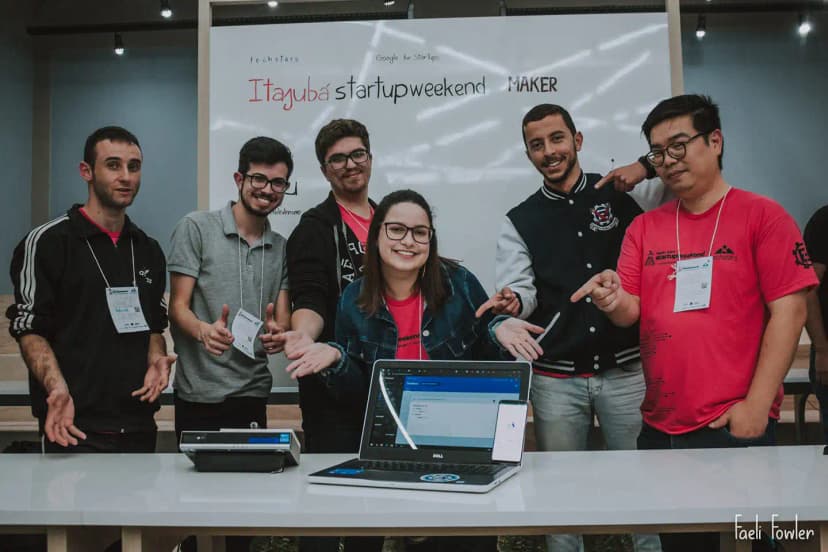
During this period, I participated in a Startup Weekend at UNIFEI and a Mega Hack in partnership with Ambev, both as the main developer. They were intense and very important experiences for my growth.
Vitta and Accelerated Growth
Still in 2020, I joined Vitta, a healthcare company in the Stone group, as a Mid-Level Full Stack. It was the phase of greatest technical growth in my career. I worked with AWS, Jenkins, ElasticSearch APM, Kubernetes, observability, API scalability in TypeScript and architecture.
After 11 months, I was promoted to Tech Lead.
In 2021, I received the opportunity to teach in an evening Full Stack course at Digital House. I worked during the day and taught classes twice a week. That's when I started creating content, officially establishing the Tsunode brand on social media.
In 2022, I created Techrmo, a game inspired by Wordle and Termo, but focused on technical words from the technology field.
Instructor and Return to Market
Still in 2022, I decided to take on a new challenge: I left my Tech Lead position and became a full-time lead instructor at a programming school. Besides teaching, I led a team of instructors and created a lot of content.
It was an extremely rich year, but in mid-2023 I decided to return to the development market, as I missed evolving technically on a daily basis.
That's when I returned to the very first software house where I started in 2019, now as Tech Lead, almost three years after my departure. The company had evolved a lot during that period. I worked again with Node, TypeScript and React, and also started working with GCP.
Internationalization and New Projects
In early 2024, I started a part-time freelance job for a Canadian company. It was my first professional contact with a foreign company, working practically solo on a project from scratch: backend, frontend, AWS infrastructure and even Web3 with smart contracts in Solidity.
That same year, I created the Me Acha Aí project, a platform to find services and places in the city simply by typing a term.
Where I Am Today
In May 2024, I went through a selection process for a US company and was accepted. I started working as a Frontend Engineer full-time.
In less than two years, I was promoted to Tech Lead and then to Engineering Manager. I implemented code review culture, testing and build pipelines, React to Next.js migration, performance improvements (from 60 to 97) and build time reduction from 5 minutes to 40 seconds.
In 2025, I created Flypage, a tool that uses AI to create landing pages quickly and affordably. That same year, I co-founded DevScout, a resume sending automation platform, where I served as COO for six months.
Today, I continue to be challenged every day — technically, professionally and personally — and I keep believing that the best part of my career is still being built.